Results you can trust, and show.
Keystone is checked against closed-form solutions, against OpenSees, an independent research-grade finite-element program, and against the published ETABS and SAFE verification problems, on every release.
relative difference from OpenSees on frames
core-wall building vs. OpenSees shells
Scordelis–Lo roof benchmark
automated tests per release
| Benchmark | Reference | Result |
|---|---|---|
| 3-D frames: static displacements, member forces, periods, ELF loads | OpenSees | ≤ 1×10⁻¹¹ relative |
| P-Delta (iterative, consistent geometric stiffness) | OpenSees / exact beam-column | ≤ 1×10⁻⁴ |
| Shell element: patch test, MacNeal beam, Cook's membrane, Navier plates, Scordelis–Lo roof | Closed form / published benchmarks | all pass, roof 0.23 % |
| Core-wall building: periods and lateral displacements | OpenSees ShellDKGQ | within 0.3 % |
| Cantilever shear wall: top drift | Timoshenko beam theory | within 1 % |
| NBC 2020 / ASCE 7-16 load generators and combinations | Hand calculations | 86 checks pass |
| CSA A23.3 and S16 member design | Hand calculations | 153 checks pass |
| Steel libraries (AISC, CSA, EN, IS, BS, AS/NZS) | Source tables and exact geometry | 292 checks pass |
The same problems ETABS is verified on.
CSI publishes the problems ETABS is verified against, with theoretical results or refined SAP2000 meshes as the reference. We rebuilt every linear one in Keystone.
| Problem | Reference | ETABS | Keystone |
|---|---|---|---|
| 1 · Plane frame with span loads: moments and shears | Theory | exact | exact |
| 2 · Three-storey frame: periods and mode shapes | Theory | exact | within 0.1 % |
| 3 · ASCE 7 equivalent static storey shears | Hand calculation | exact | within 0.01 % |
| 4, 5, 8 · 3-D frames and braced building: periods, modes, spectrum response | Theory / published | within 0.3 % | within 0.3 % |
| 6 · Nine-storey, ten-bay frame: eigenvalues | Published | within 0.1 % | identical to ETABS |
| 15 · Shear walls, coupled walls, wall on columns, C, E and flanged walls: lateral displacements and twists (30 values) | SAP2000 refined mesh | stiffer in 26 of 30, by up to 22 % | 19 of 30 within 1 %, 25 within 4 %, median 0.4 %* |
*All values use Keystone's default shell walls. The outliers are the C-shaped wall under load along its web (6 storeys: 20 % stiffer in displacement, 26 % in twist; 3 storeys: 7–8 %) and a 0.0005-radian twist published to one significant figure. CSI does not state which wall element its C-wall model used; modelled as membrane walls (no out-of-plane bending), Keystone matches it within 0.3 %, while the E-wall matches as shell walls. Problems that need nonlinear links, time history or data not in the manual (7, 9, 10–14) are not included.
Slab design, checked the same way.
CSI's SAFE verification problems for plate analysis, punching shear, slab flexure and cracked deflection, rebuilt in Keystone on SAFE's own meshes. Thin-plate results are shown; the thick-plate versions agree within 5%.
| Problem | Quantity | SAFE / hand calculation | Keystone |
|---|---|---|---|
| CSA A23.3-14 RC-PN-001 · flat plate, interior column | Punching stress / resistance / D/C | 1.792 / 1.127 MPa / 1.59 | 1.792 / 1.127 MPa / 1.59 |
| ACI 318-14 RC-PN-001 · flat plate, interior column | Punching stress / resistance / D/C | 0.193 / 0.158 ksi / 1.22 | 0.193 / 0.158 ksi / 1.22 |
| CSA A23.3-14 RC-SL-001 · one-way slab, 1 m strip | Strip moment / bottom steel | 25.00 kN·m / 5.414 cm² | 25.00 kN·m / 5.406 cm² |
| Example 1 · simply supported plate, uniform / point / line load | 12 deflections and 12 strip moments | all within 0.4% of SAFE | |
| Example 2 · plate with fixed edges, point load | Centre deflection | 0.0598 in | 0.0598 in |
| Example 3 · plate with mixed edge conditions | Free-edge deflection | 0.5502 in | 0.5502 in |
| Example 4 · plate on flexible edge beams | Centre deflection / beam moment | 0.1854 in / 1,120.4 kip-in | 0.1854 in / 1,120.4 kip-in |
| Example 5 · infinite flat plate on columns | 7 deflections and 8 strip moments | all within 0.5% of SAFE | |
| Example 6 · infinite plate on elastic subgrade | Deflection under load / moment | 0.05405 in / 37.99 kip-in/in | 0.05405 in / 37.99 kip-in/in |
| Example 7 · skew plate, free obtuse edge | Free-edge deflection / max moment | 1.510 in / 12.03 kip-in/in | 1.511 in / 12.34 kip-in/in† |
| Example 16 · cracked slab deflection, creep and shrinkage | Short-term / long-term deflection | 13.55 / 24.51 mm (hand 14.4 / 23.9) | 13.40 / 23.84 mm |
| Flat plate, 3 × 8 m bays · statics across all strips | Midspan + mean support moment = w·l2·l1²/8 | 2,973.6 kN·m | 2,973.6 kN·m |
| Beam on elastic foundation (Hetényi), point load | Deflection under the load | 0.931 mm (closed form) | 0.934 mm |
| Footing with uplift, e > B/6, compression-only soil | Maximum soil pressure | 266.7 kPa (closed form) | 265.6 kPa |
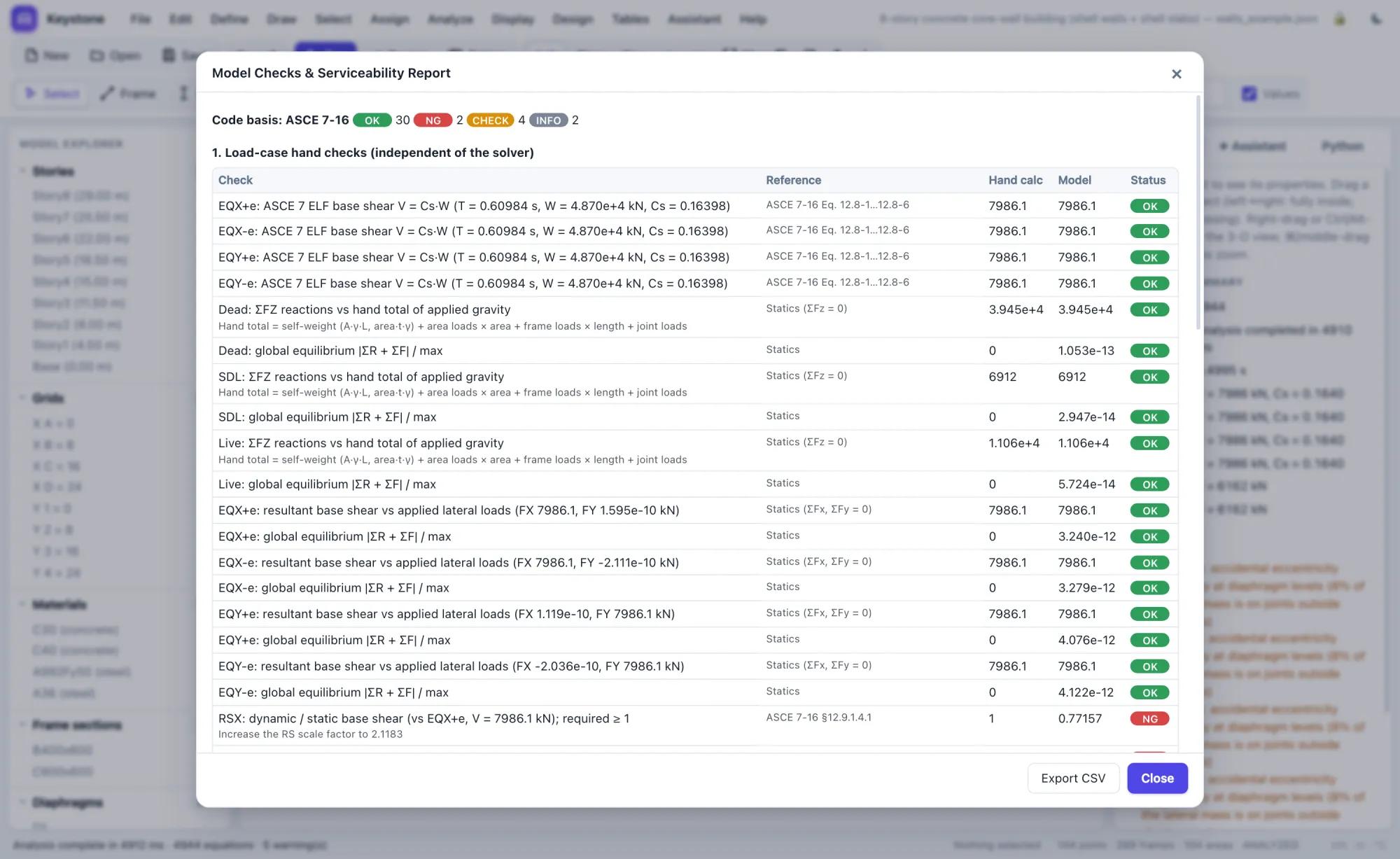
A hand-check report with every analysis
Beyond release testing, each analysis recomputes every load case independently of the solver (gravity totals, code base shear, wind pressures, spectrum scaling) and checks drift, deflection, uplift and wall cracking against their limits, citing the clause for each.
Compare it with your own results.
Bring an ETABS model and we'll help you compare.